

5 Reasons to Learn Lithuanian with Kalbukas
27/09/2026
Ask a shop assistant where to find your favourite Lithuanian dumplings instead of spending half an hour wandering around the supermarket looking for them. Tell someone what you did at the weekend before they take pity and switch to English. Answer your partner’s mum yourself, so your partner can finally finish a meal without providing simultaneous interpretation.
These are the kinds of small victories Kalbukas is built for. It’s a Lithuanian learning app where you practise speaking, get help when you’re stuck, and have another go before someone is waiting behind you in the queue.
Here are five reasons to make Kalbukas part of your Lithuanian learning routine.
1. There’s a Lithuanian behind it
Having a Lithuanian developer means someone can look at a perfectly grammatical sentence and ask, “But would we actually say that?”
That local knowledge shapes the situations you practise, the language you hear, and the feedback you receive. It helps us notice details that can get missed when Lithuanian is treated as another language to add to a menu.
You’re learning to speak to Lithuanians. It helps to have one involved. Preferably before you’ve memorised something nobody has said since 1936.
2. The phrases should fit you
Suppose you learn Aš pavargęs, meaning “I’m tired.” Useful. Easy to remember. Quite possibly true.
But if you use feminine grammatical forms, you’d say Aš pavargusi.
You could memorise the first version perfectly and still have learned the wrong form for yourself. Language apps can overlook this when they give everyone the same examples.
Kalbukas uses your selected grammatical gender when referring to you. You already have enough endings to learn without discovering that your carefully rehearsed introduction needs alterations.
3. The practice takes you to Lithuania
You’ve learned how to order a coffee. Then the barista asks which milk you want, and suddenly you’re considering drinking it black forever.
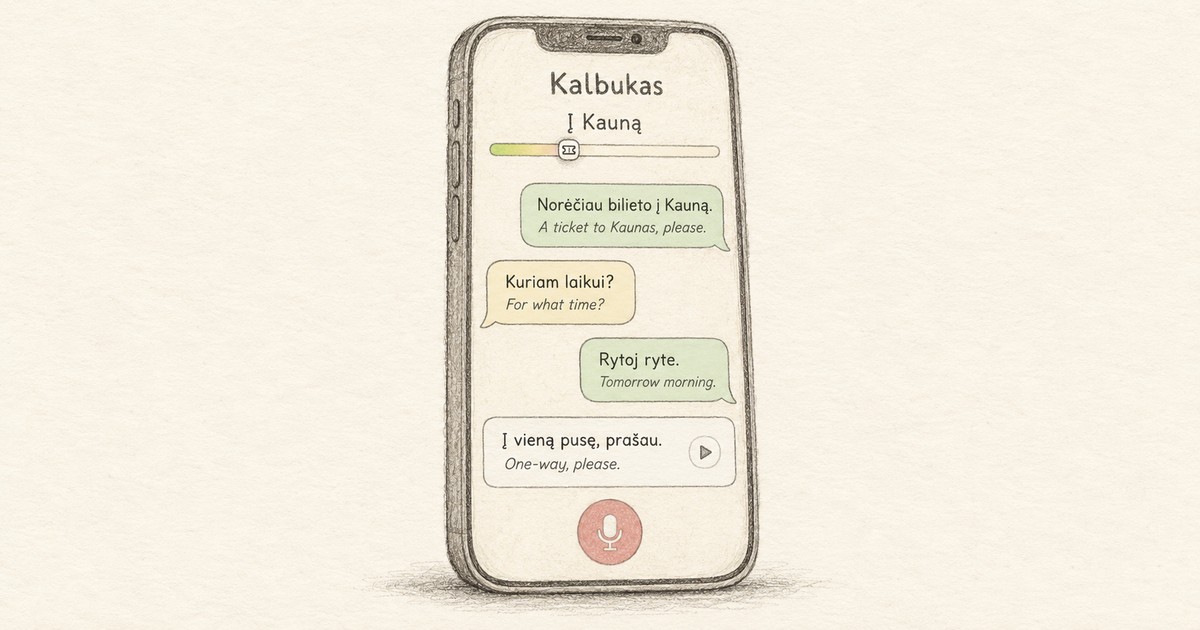
Kalbukas gives you speaking missions such as ordering coffee in Vilnius, buying a train ticket to Kaunas, and asking for directions to Cathedral Square.
You practise the exchange: making your request, answering questions, checking what someone means, and finishing the conversation.
Localisation can get reduced to translated menus and a flag. We think it should also prepare you for the person on the other side of the counter.
Including the moment when you need to say, “Sorry, could you repeat that?” A phrase that deserves considerably more fame than it gets.
4. Natural speech doesn’t automatically get a red pen
You learn esame. Lithuanians say esam.
You learn turiu omenyje. Someone says turiu omeny.
Nobody is trying to sabotage your studies. These are familiar shortcuts in everyday speech.
An app expecting a fixed written answer can mark a spoken shortcut as a mistake. Kalbukas is designed to accept common conversational shortenings when they fit the context. Its feedback focuses on things that would sound wrong or make your meaning unclear.
The fuller forms are still useful, especially in formal writing. But you shouldn’t need to address Parliament just to explain what you meant.
5. You can get the awkward attempts out of the way
Knowing an answer and saying it out loud are different experiences. Especially when someone is waiting and you’ve suddenly forgotten a word you knew ten seconds ago.
With Kalbukas, you speak into the microphone and get a reply. You can read the transcript, check an English translation, and use suggestions when you need help.
Then you try again.
Practise before meeting your partner’s parents. Rehearse an errand before leaving home. Repeat a conversation because your first attempt contained three words and a silence long enough to suggest you were considering a different career.
Nobody’s coffee is getting cold while you work it out.
Try it before your next conversation
Pick something you’d like to handle in Lithuanian. Ordering lunch. Buying a ticket. Asking for directions and understanding enough of the answer to get there.
Try Kalbukas and give that conversation a practice run.
We can’t stop the Lithuanians asking a second question. We can help you get ready for it.